


Running Toilets and High Water Bills in Santa Cruz: Small Parts That Waste Big Water
A higher-than-expected water bill can be frustrating, especially during late summer in Santa Cruz. With more water being used for garden irrigation, visiting guests, extra laundry and outdoor cleaning, it is easy to assume the seasonal increase is normal.
However, a running toilet or silent toilet leak may also be adding to the problem. In many cases, the cause is not a visibly damaged toilet but a small part inside the tank. Worn flappers, faulty fill valves, incorrect float settings or loose flush chains can allow water to escape continuously between the tank and bowl, gradually increasing household water use without drawing immediate attention.
Why Toilet Leaks Are Harder to Notice During Late Summer
Santa Cruz water use often changes during warmer months, making a gradual toilet leak easier to overlook. When several seasonal activities increase consumption at the same time, homeowners may assume an unexpected high water bill is entirely normal.
Common reasons for increased late-summer water use include:
- More frequent landscape irrigation
- Additional laundry from visitors or outdoor activities
- More showers and bathroom use when guests are staying
- Cleaning patios, outdoor furniture or equipment
- Children spending more time at home
- Irrigation leaks occurring alongside indoor plumbing leaks
Santa Cruz Municipal Utilities advises customers to check both toilets and irrigation systems when investigating possible leaks. Part of a summer water bill increase may come from continuous toilet water waste rather than seasonal use alone.
Warning Signs That a Toilet Is Wasting Water
A toilet does not need to run loudly all day to waste water. Short refill cycles, faint sounds or unexplained movement in the bowl can indicate that water is escaping from the tank.
| Warning sign | What the homeowner may notice |
| Constant running | Water continues flowing after the flush has finished |
| Random refilling | The toilet runs randomly even when no one has used it |
| Hissing sound | A quiet toilet hissing sound continues near the fill valve |
| Water moving in the bowl | Ripples appear between flushes |
| Handle must be moved | The chain or flapper may not close correctly |
| Higher water bill | Household use increases without an obvious reason |
| Silent leak | Water passes into the bowl without noticeable noise |
Phantom flushing or a toilet that keeps refilling often signals a silent toilet leak inside the tank.
The Small Toilet Parts Most Likely to Cause a Leak
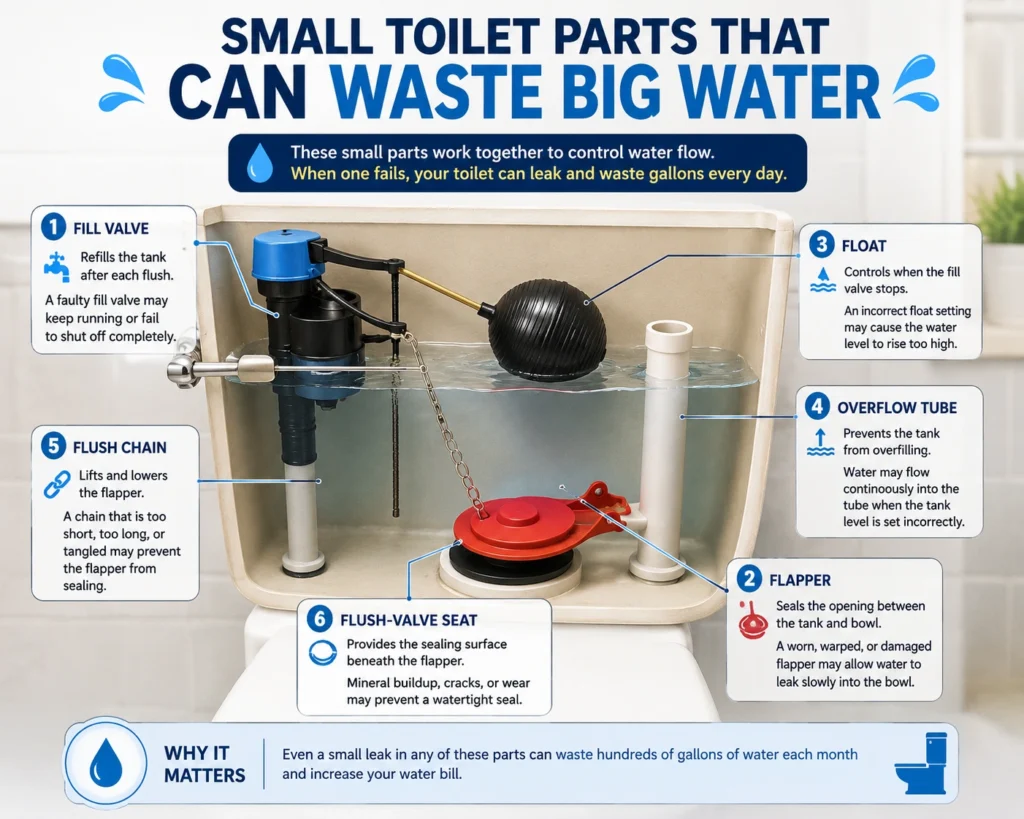
Several small components inside the toilet tank control how water enters, stops and moves into the bowl. When one of these parts becomes worn, misaligned or coated with mineral deposits, the toilet may begin wasting water even though the problem is not immediately visible.
| Toilet component | Its purpose | How it may waste water |
| Flapper | Seals the opening between the tank and bowl | A worn, warped or damaged flapper may allow water to leak slowly into the bowl |
| Fill valve | Refills the tank after flushing | A faulty fill valve may continue supplying water or fail to shut off completely |
| Float | Controls when the fill valve stops | An incorrect float setting may cause the water level to rise too high |
| Overflow tube | Prevents the tank from overfilling | Water may flow continuously into the tube when the tank level is set incorrectly |
| Flush chain | Lifts and lowers the flapper | A chain that is too short, too long or tangled may prevent the flapper from sealing |
| Flush-valve seat | Provides the sealing surface beneath the flapper | Mineral buildup, cracks or deterioration may prevent a watertight seal |
A leaking toilet flapper is one of the most common causes of water passing silently from the tank into the bowl. Fill valve problems may instead cause constant refilling, hissing or water entering the overflow tube. Because several parts can produce similar symptoms, identifying the exact source is important before replacing any component.
A Worn Toilet Flapper
The flapper forms a watertight seal between the toilet tank and bowl after each flush. Over time, age, mineral deposits, warping or general deterioration can prevent it from sitting flat against the flush-valve seat. A leaking toilet flapper may allow water to pass slowly into the bowl, causing the tank to refill even when the toilet has not been used.
A simple dye test can help identify this problem. If coloured water moves from the tank into the bowl without flushing, the leak is likely occurring around the flapper or flush-valve seal. Santa Cruz leak guidance notes that this result may indicate that the flapper valve needs to be replaced.
Fill Valve and Float Problems
Toilet fill valve problems can also cause continuous water loss. The fill valve controls how water enters the tank, while the float signals when the tank has reached the correct level.
If the float is adjusted too high, water may continue flowing into the toilet overflow tube. A failing fill valve may also struggle to shut off completely, leading to hissing, repeated refilling or constant water movement. These toilet tank parts should be checked when a toilet keeps running or water is continually entering the overflow tube.
How to Check a Toilet for a Silent Leak
Perform a Toilet Dye Test
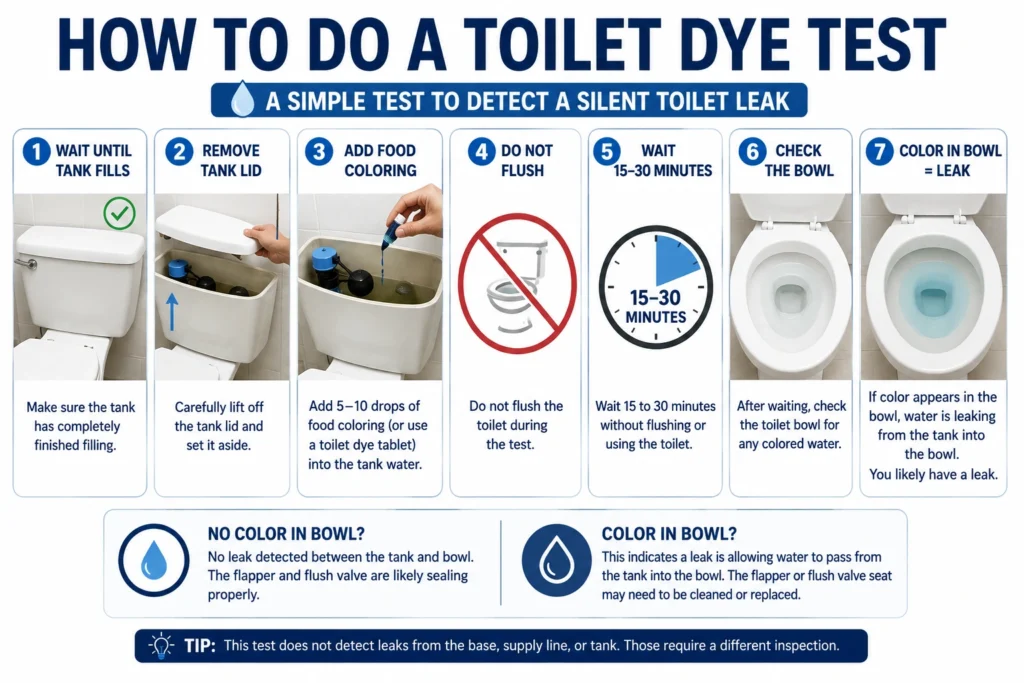
A simple dye test can reveal whether water is leaking silently from the tank into the bowl.
- Wait until the toilet tank has finished filling.
- Carefully remove the tank lid.
- Add several drops of food colouring or a toilet dye tablet to the tank.
- Do not flush the toilet.
- Wait approximately 15 to 30 minutes.
- Check the toilet bowl for coloured water.
- If colour appears, water is passing from the tank into the bowl.
Santa Cruz leak-help guidance recommends adding dye to the tank, waiting without flushing and checking whether the colour reaches the bowl.
Check for Continuous Water Use
Homeowners should also:
- Listen near the tank for hissing or trickling.
- Look for water entering the overflow tube.
- Check whether the tank refills while unused.
- Observe the water meter after turning off all fixtures and appliances.
- Review WaterSmart consumption data or activate leak alerts when available.
Before attempting any repair, shut off the toilet’s water supply. Avoid dismantling complicated components when the leak source is unclear or several toilet parts may be faulty.
Is the Higher Bill from the Toilet or Normal Household Use?
| Possible cause | Pattern to look for |
| Irrigation | Usage rises on scheduled watering days |
| Guests | Consumption increases during a specific visit |
| Additional laundry | Usage increases with more washing cycles |
| Outdoor cleaning | The increase follows patio or outdoor-area cleaning |
| Running toilet | Water use continues throughout the day and night |
| Silent tank leak | The toilet refills when no one has flushed it |
| Pipe leak | Meter activity continues after toilets and fixtures are checked |
A high water bill toilet leak may not be the only cause of increased consumption. Seasonal activities, guests and a hidden household leak can occur at the same time. Homeowners should check each toilet separately, review recent changes in household water use and perform a water meter leak check when all fixtures and appliances are off. Santa Cruz meters may show a continuous-use indication when ongoing flow suggests a possible leak.
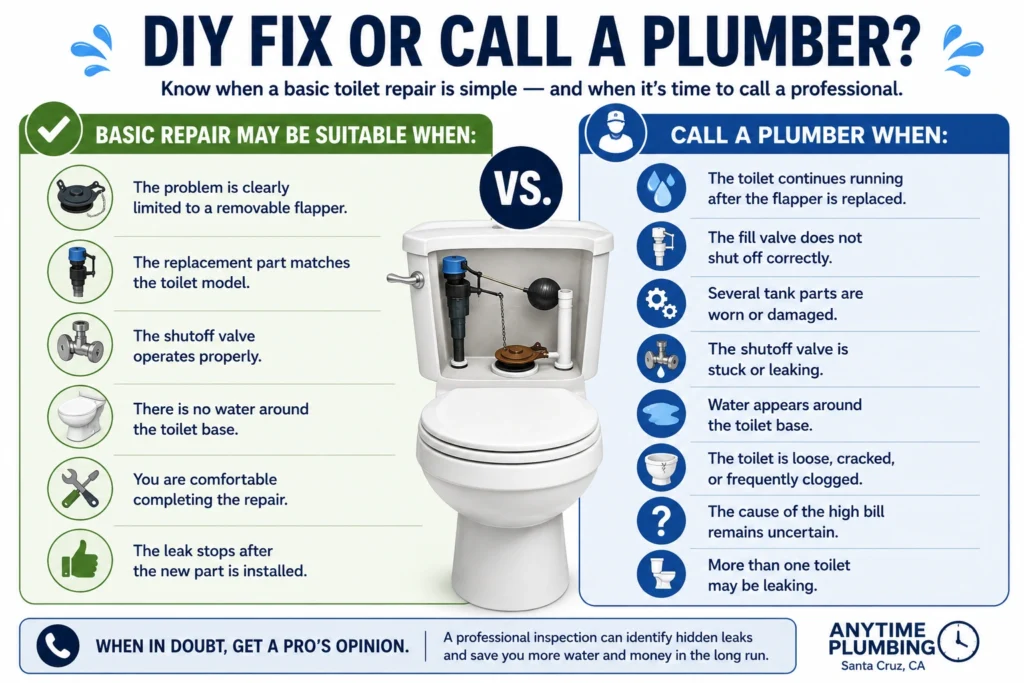
Repairing a Small Part Versus Calling a Plumber
| A basic repair may be suitable when: | Contact a plumber when: |
| The problem is clearly limited to a removable flapper | The toilet continues running after the flapper is replaced |
| The replacement part matches the toilet model | The fill valve does not shut off correctly |
| The shutoff valve operates properly | Several tank parts are worn or damaged |
| There is no water around the toilet base | The shutoff valve is stuck or leaking |
| The homeowner is comfortable completing the repair | Water appears around the toilet base |
| The leak stops after the new part is installed | The toilet is loose, cracked or frequently clogged |
| The cause of the high bill remains uncertain | |
| More than one toilet may be leaking |
Anytime Plumbing provides toilet diagnosis and repair throughout Santa Cruz and nearby Santa Cruz County communities. A professional inspection can identify running toilets, leaks around the base and plumbing problems contributing to higher-than-normal water bills.
A Simple Toilet-Leak Prevention Checklist
Regular toilet maintenance can help prevent toilet leaks and reduce water waste.
- Test each toilet periodically with food colouring.
- Listen for refilling when bathrooms are not in use.
- Confirm that the flapper closes fully after flushing.
- Keep the flush chain free from tangles.
- Check for water entering the overflow tube.
- Review water-use alerts and unusual consumption.
- Investigate unexplained bill increases promptly.
- Replace deteriorated tank components before they fail.
- Arrange a professional toilet leak inspection when the source remains unclear.
Stop a Small Toilet Leak Before It Becomes a Bigger Bill
If your toilet runs or refills unexpectedly, the cause of a high water bill is unclear, or replacing the flapper has not solved the problem, contact Anytime Plumbing. For professional toilet repair in Santa Cruz and nearby communities, call 831-431-6593 to schedule an inspection.
Frequently Asked Questions
Yes. Water can move slowly from the tank into the bowl without producing an obvious running, hissing or trickling sound.
A worn or misaligned flapper may allow water to escape, lowering the tank level and activating the fill valve.
Yes. A fill valve that does not shut off correctly may allow continuous water flow, increasing household consumption over time.