

Why Does My Faucet Keep Dripping Even When It’s Turned Off? Common Causes and Solutions
You turn off your kitchen or bathroom faucet, but water continues dripping from the spout. If your faucet keeps dripping when turned off, the cause may be more than a little leftover water. While a few drops are normal, especially with tall or curved spouts, continuous dripping often indicates that an internal component is not sealing properly.
Worn cartridges, deteriorated washers, damaged seals, and faulty valve components are common reasons faucets develop leaks. Identifying the source of the problem is important before attempting repairs or replacing the entire fixture. This guide explains the common causes, how to recognize different symptoms, and when professional faucet repair may be necessary.
Is It Normal for a Faucet to Drip After Being Turned Off?
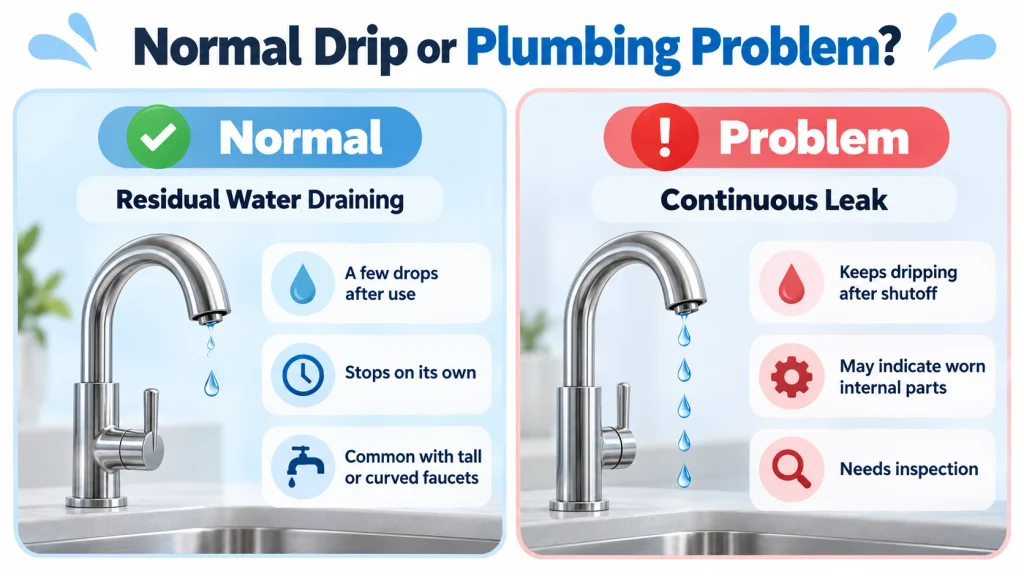
A few drops of water after turning off a faucet are not always a sign of a problem. However, there is an important difference between leftover water draining from the spout and a faucet that continues leaking.
Residual Water Draining From the Spout
Tall, curved, and pull-down faucets can hold small amounts of water inside their spouts after the valve closes. This remaining water may gradually drain out, causing occasional drops. Some high-arc faucets may continue releasing residual water for several minutes before stopping completely. If the dripping eventually stops, it may be normal drainage rather than a faulty component.
A Faucet That Continues Dripping
If water keeps dripping at regular intervals long after the faucet is turned off, an internal valve or seal may not be closing properly. Dripping that becomes faster or develops into a thin, continuous stream indicates a problem that should be investigated promptly.
What Causes a Faucet to Keep Dripping When It’s Turned Off?
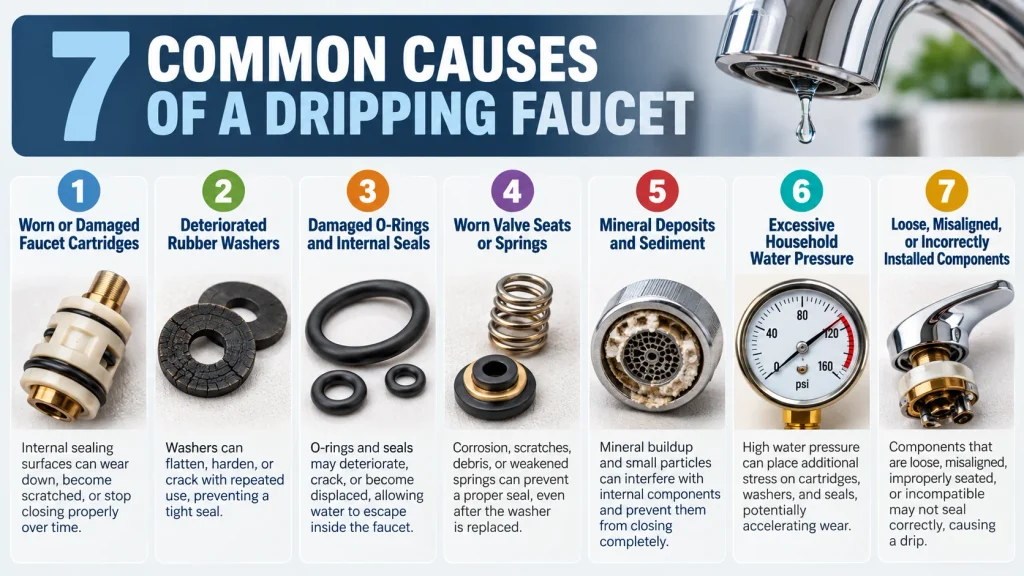
A faucet that continues dripping after being turned off usually has a problem with one or more internal components responsible for controlling water flow. The exact cause depends on the faucet’s design, age, and condition. Here are seven common reasons a faucet may fail to shut off completely.
1. Worn or Damaged Faucet Cartridges
Modern single-handle faucets and many two-handle models use cartridges to regulate water flow. Over time, internal sealing surfaces can wear down, become scratched, or stop closing properly.
Common signs include:
- Continuous dripping despite fully closing the handle.
- Difficulty adjusting water temperature or flow.
- A stiff or unusually loose faucet handle.
Replacing the damaged cartridge often resolves the leak. However, cartridges are model-specific, so the replacement must match the faucet’s manufacturer and design.
2. Deteriorated Rubber Washers
Traditional compression faucets use rubber washers that press against valve seats to stop water flow. Repeated use can gradually flatten, harden, or crack these washers.
When a washer no longer forms a watertight seal, water can escape through the spout. Replacing it may solve the problem if the valve seat remains undamaged.
Not all modern faucets contain traditional compression washers.
3. Damaged O-Rings and Internal Seals
O-rings and gaskets help create watertight connections inside faucets. These rubber components may deteriorate, crack, or become displaced over time.
Depending on their location, damaged seals can cause:
- Dripping from the faucet spout.
- Water leaking around the handle.
- Moisture collecting around the spout base.
Identifying where water escapes helps determine which seal may need replacement.
4. Worn Valve Seats or Springs
Some faucets rely on valve seats or spring-loaded rubber seals to stop water flow.
Common problems include:
- Corrosion or scratches on sealing surfaces.
- Debris preventing a tight seal.
- Weakened springs that no longer provide sufficient sealing pressure.
A damaged valve seat may continue leaking even after its washer is replaced.
5. Mineral Deposits and Sediment Inside the Faucet
Mineral buildup and small particles carried through water lines can interfere with faucet components.
Deposits may prevent cartridges or valves from closing completely, allowing water to pass through. Cleaning accessible components may restore proper operation, but scratched or damaged parts generally require replacement.
6. Excessive Household Water Pressure
High water pressure can place additional stress on faucet cartridges, washers, and seals, potentially accelerating wear.
Although pressure alone is not always responsible for dripping, recurring leaks across multiple fixtures may justify professional water-pressure testing.
7. Loose, Misaligned, or Incorrectly Installed Components
A faucet may continue dripping because its internal components are not positioned or assembled correctly.
Possible causes include:
- An improperly seated cartridge.
- Incorrect or incompatible replacement parts.
- Worn handle mechanisms.
- Improper reassembly after repairs.
If dripping continues after replacing a component, the original problem may remain unresolved or another internal part may require attention.
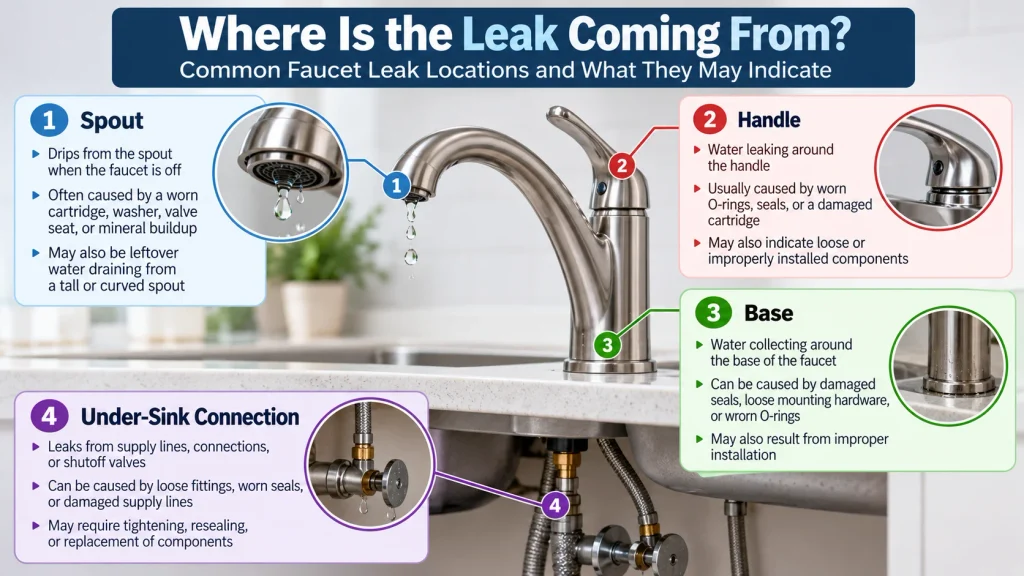
Where Is the Water Leaking From? Understanding the Different Symptoms
The location of a faucet leak can provide useful clues about which component may be failing. Before attempting repairs, observe where water appears and whether the leak occurs when the faucet is running, turned off, or both.
Different symptoms often point to different problems:
| Visible Symptom | Possible Explanation |
| Water dripping from the spout while off | Worn cartridge, washer, valve seat, or related seal |
| Water appearing around the handle | Damaged seal, cartridge issue, or loose component |
| Water leaking around the spout base | Worn spout O-rings or seals |
| Water collecting beneath the sink | Leaking supply connection, hose, or faucet mounting area |
| Brief dripping after use | Residual water draining from the spout |
Not every faucet leak originates inside the shutoff mechanism. Water can escape around the faucet base or beneath the sink even when the spout is not dripping.
These leaks require checking different components, including supply hoses, mounting connections, and external seals. Identifying the exact leak location helps narrow down the problem and prevents unnecessary replacement of functioning parts.
How to Identify Why Your Faucet Keeps Dripping
Before replacing any faucet components, a few simple checks can help you narrow down the cause of the leak. Follow these steps to identify possible problems.
Step 1: Observe How Long the Dripping Continues
Turn off the faucet and watch the spout. A few drops immediately afterward may be leftover water draining out. However, dripping that continues well after use could indicate a faulty internal seal or valve.
Step 2: Check Exactly Where Water Appears
Inspect the faucet carefully, paying attention to:
- The spout opening.
- The handle and surrounding area.
- The faucet base.
- Visible supply hoses and connections beneath the sink.
The leak’s location can help identify which components need attention.
Step 3: Determine Whether Hot or Cold Water Is Responsible
For faucets with accessible, separate hot and cold shutoff valves, carefully isolating each supply may help identify the leaking side. However, not every faucet configuration allows this type of testing.
Step 4: Notice Changes in Handle Operation
A stiff, loose, or difficult-to-close handle may indicate a worn cartridge, damaged mechanism, or misaligned internal component. Avoid forcing the handle closed.
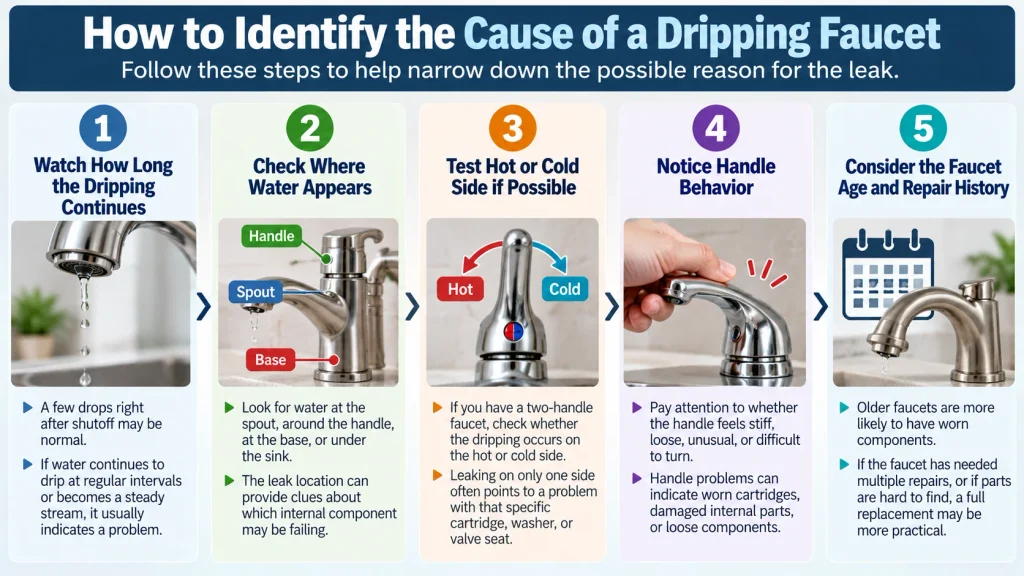
Step 5: Consider the Faucet’s Age and Repair History
Think about whether the faucet has leaked previously or recently undergone repairs. Recurring dripping after cartridge replacement may indicate another unresolved problem.
These observations can narrow down the possible causes, but an accurate diagnosis may require disassembly or professional plumbing inspection.
Can You Fix a Dripping Faucet Without Replacing the Entire Fixture?
Many dripping faucets can be repaired without replacing the entire fixture. If the faucet body is in good condition, replacing a worn internal component may be enough to restore proper operation.
Repairs That May Resolve the Problem
The appropriate repair depends on the faucet’s design and the component causing the leak. Common solutions include:
- Replacing worn washers or gaskets: Restores a watertight seal in applicable faucet designs.
- Installing a new cartridge: Corrects leaks caused by worn or damaged cartridge mechanisms.
- Replacing O-rings or seals: Addresses leaks caused by deteriorated rubber components.
- Cleaning sediment buildup: Removes debris that may prevent internal valves from closing properly.
- Replacing valve seats or springs: Restores proper sealing where these components are replaceable.
Always choose replacement parts compatible with the faucet’s manufacturer and specific model.
What Homeowners Should Know Before Attempting Repairs
Before disassembling a faucet, take these precautions:
- Shut off the appropriate water supply and verify that water has stopped flowing.
- Avoid forcing stuck or corroded components.
- Never overtighten the handle to stop dripping.
- Stop if the shutoff valve fails or the repair involves unfamiliar plumbing work.
If the problem remains unclear, professional inspection can help prevent unnecessary repairs or accidental damage.
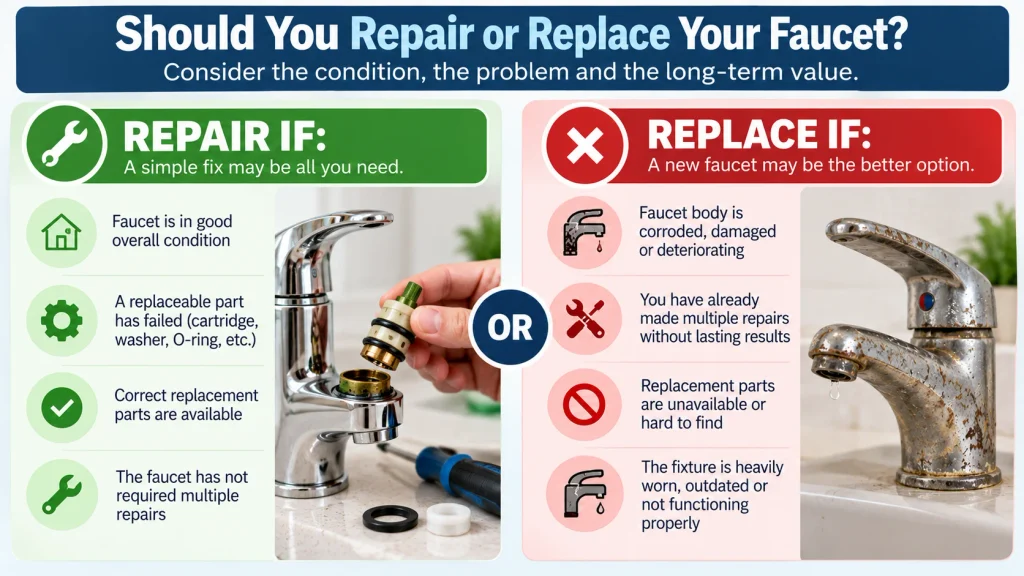
Should You Repair or Replace a Dripping Faucet?
Deciding whether to repair or replace a dripping faucet depends on its overall condition, the cause of the leak, and the availability of compatible replacement parts. Many faucet problems can be resolved with minor repairs, but replacement may be more practical in certain situations.
When Faucet Repair Is Usually the Better Option
Repairing your existing faucet generally makes sense when:
- The faucet body is in good condition without significant corrosion or damage.
- The leak comes from a replaceable cartridge, washer, or seal.
- Compatible replacement parts are readily available.
- The fixture operates normally and has no history of repeated failures.
When Replacing the Faucet May Make More Sense
A complete replacement may be preferable when:
- Internal corrosion or structural damage affects the faucet body.
- Replacement components are discontinued or unavailable.
- Previous repair attempts have repeatedly failed.
- The faucet is heavily deteriorated or no longer functions reliably.
Replacing an older faucet also provides an opportunity to choose a water-efficient model that helps reduce unnecessary water consumption.
Why Fixing a Dripping Faucet Matters in Santa Cruz County
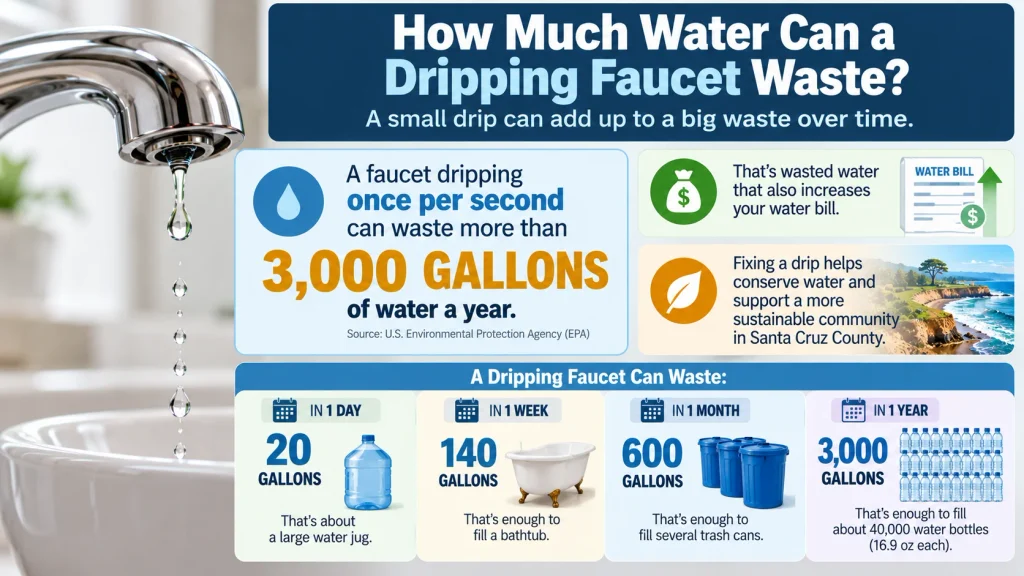
Even a small, persistent faucet drip can waste a surprising amount of water over time. According to the U.S. Environmental Protection Agency (EPA), a faucet dripping once per second can waste more than 3,000 gallons of water annually. This unnecessary water consumption can also contribute to higher household water bills.
Water conservation is particularly important in Santa Cruz County, where communities depend on local surface water and groundwater resources. Repairing minor plumbing leaks is a practical way to help conserve these supplies.
Santa Cruz County also recommends fixing leaky faucets and toilets as part of responsible household water conservation. Whether the problem involves a worn washer or a faulty cartridge, addressing persistent dripping early helps reduce water waste and unnecessary expenses.
When Should You Call a Plumber for a Dripping Faucet?
While some faucet leaks can be resolved with simple repairs, certain problems require professional attention. Consider contacting a plumber if:
- Dripping continues after replacing a washer or cartridge.
- The faucet will not shut off completely.
- Multiple fixtures develop recurring leaks.
- You notice corrosion, hidden moisture, or deteriorating components.
- The water shutoff valve does not work properly.
- Compatible replacement parts are difficult to identify.
A professional plumber can inspect the fixture, identify the underlying problem, and determine whether repair or replacement is appropriate.
Anytime Plumbing helps homeowners throughout Santa Cruz County diagnose persistent faucet leaks and find suitable repair solutions. Substantial, uncontrolled leaks or signs of active water damage should receive prompt attention.
Schedule Faucet Leak Repair With Anytime Plumbing: Call 831-431-6593 for professional assistance.
How Can You Prevent Faucets From Dripping in the Future?
Although normal wear cannot be completely prevented, proper use and regular maintenance can help extend your faucet’s lifespan and reduce the likelihood of recurring leaks.
Follow these practical maintenance tips:
- Avoid overtightening handles: Turn faucets off gently without applying unnecessary force.
- Address handle problems early: Investigate stiff, loose, or difficult-to-operate handles before they worsen.
- Keep components clean: Clean accessible faucet parts according to the manufacturer’s recommendations.
- Watch for performance changes: Pay attention to reduced water flow, unusual pressure changes, or difficulty controlling water temperature.
- Investigate recurring drips: Identify the underlying problem instead of repeatedly tightening the handle.
- Monitor water pressure: Have suspected excessive household water pressure professionally evaluated.
Recognizing early warning signs can help prevent unnecessary water waste and more extensive faucet damage.
Stop Small Faucet Drips Before They Become Bigger Plumbing Problems
A few drops after turning off your faucet may be normal, but persistent dripping often indicates worn cartridges, washers, seals, or other internal components. Identifying the underlying cause helps determine whether a simple repair or complete faucet replacement is necessary. Addressing leaks promptly also prevents unnecessary water waste.
Anytime Plumbing provides plumbing repair services throughout Santa Cruz County, including Santa Cruz, Watsonville, Aptos, Scotts Valley, Capitola, and Soquel.
Need help with a dripping faucet? Contact Anytime Plumbing at 831-431-6593 for professional assistance with persistent faucet leaks.
Frequently Asked Questions
If your faucet continues dripping after cartridge replacement, the new cartridge may be incompatible or incorrectly installed. Damaged sealing surfaces, trapped sediment, or another worn internal component could also be responsible. Check that the replacement matches your faucet model and is properly seated before investigating other possible causes.
Some faucets, particularly tall or curved models, retain water inside the spout after being turned off. This leftover water may gradually drain out, causing occasional dripping for several minutes. If the dripping stops completely, it may be normal. Continuous dripping, however, suggests a possible internal sealing problem.
Yes. Even a slow, persistent drip adds to your household's water consumption over time. The financial impact depends on how frequently the faucet drips and your local water rates. Repairing the leak promptly can help reduce unnecessary water usage and prevent avoidable increases in your water bill.
A newly installed faucet may drip because of an improperly seated cartridge, trapped debris, defective seals, or incorrect installation. Manufacturing defects are another possibility. Check the manufacturer's troubleshooting instructions and warranty coverage. If the dripping persists, have the installation and internal components inspected before attempting further repairs.
A faucet aerator controls the water stream and may temporarily retain a small amount of water after use. Cleaning or replacing it may address irregular flow or residual dripping. However, an aerator replacement generally cannot stop continuous leakage caused by a worn cartridge, damaged washer, or faulty internal valve.