

What To Do When Your Hot Water Heater Is Leaking
- By: Amer ZaghloulehLeaks, Water HeaterComment: 0
Most of us take our water heaters for granted and it’s easy to understand why. You turn on the faucet in your shower or sink and within moments, you have all the hot water you need to do the dishes or get cleaned up. But then one day, you notice water pooling on the floor beneath your water heater and you realize something’s wrong. While you may think this is only a minor inconvenience, it can quickly become a more serious problem if you don’t address the issue by calling Anytime Plumbing to fix your water heater problem immediately.
What most people fail to realize is that even the slightest amount of water can lead to costly damage to your flooring, sub-flooring, and walls. A leaking water heater may be an indication that a more serious problem exists. In the more extreme cases, complete failures of this appliance have resulted in significant flooding to a person’s property and tens of thousands of dollars in damage. This all could’ve been prevented with a little preventative maintenance and calling us the moment the problem was discovered. With our emergency team available 24/7, you can be sure you are reaching out to licensed and experienced plumbers when there is any leak or clog in the plumbing system.
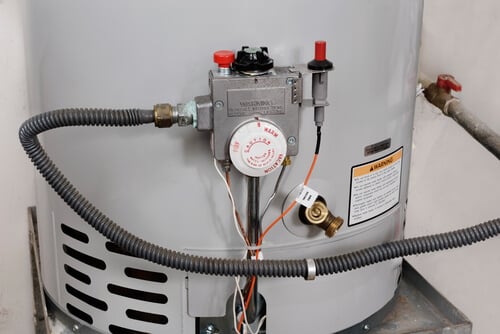
What are the key components of a water heater?
In reality, the way your water heater works isn’t such a simple process. It involves a detailed, intricate process even for the simplest of tasks such as washing your hands. Thus, it’s important to know what its key components are. Here is a breakdown of the 6 main components of your water heater:
- Dip tube – the entry point for water
- Drain valve – as the name implies, these valves enable water to drain from the tank
- Pressure relief valve – the safety device that prevents the internal tank pressure from building up to dangerous levels and potentially exploding
- “Sacrificial” anode rod – made from either aluminum or magnesium, this rod attracts rust in order to keep the water and tank safe
- Tank – the largest component; has an average capacity of 40 to 60 gallons
- Thermostat – controls the temperature of the water in the tank
Water travels the water lines and enters the water heater through the dip tube until it reaches the bottom of the tank. At that point, the heating mechanism heats the water up to the setting on the thermostat. Pressure builds inside the tank, forcing the hot water to the top where it exits through the heat-out pipe and travels to the fixture that you’ve opened or turned on. At the same time, the pressure relief valve is maintaining a safe pressure within the tank. If there is any crack or leak, it can damage the unit.
What does it mean when a water heater is leaking?
In addition to the potential for structural damage to your home, a leaking water heater could also be a concern for a family member that is prone to allergic reactions of suffers with asthma. Damp and wet areas are an ideal breeding ground for mildew and mold, which can be toxic and cause severe problems for individuals with respiratory issues.
Water leaks won’t just go away and will only become increasingly worse over time. If you’ve noticed that your water heater is leaking, it may be time to call Anytime Plumbing and have one of our specialists determine what the problem is and whether or not it can be repaired. If the water heater can be repaired, you’ll be informed of the costs and if it needs replacement, our experts will be honest about it.
Is your water heater leaking from the bottom or the top?
Although you may fear the worst, the problem may not be that serious. In fact, most water heater problems are rather simple to fix. The first thing you need to determine is if the water heater is leaking from the bottom or the top. If the water heater is leaking from the bottom it may be a faulty drain valve, pressure relief valve, or temperature valve.
Replacement of the water heater may be necessary if either of these components cannot be repaired. However, on the other hand, if the leak is at the top of the water heater, this is relatively easy to repair. This is usually an indication of a leaking ball valve, cold water inlet valve, or outlet pipe. Depending on what is repaired, the average cost to repair a water heater is $571 ($217 on the low end; $929 on the high end).
For additional information regarding water heater problems and the cost to repair them, contact Anytime Plumbing today. We’d like to help you resolve the issue quickly and efficiently.
Frequently Asked Questions
If your water heater has a small but ongoing leak, first shut off the water supply and turn off the power or gas. Place a container under the leak to prevent water damage. Even minor leaks can worsen, so call a licensed plumber to inspect and repair it promptly.
If you notice a leak or plumbing issue, first turn off the main water supply to prevent further damage. Catch dripping water with a bucket, use towels to protect floors, and avoid using affected faucets or appliances until a plumber arrives.
Sometimes homeowners notice a small leak from their water heater and wonder if it can be fixed without replacing the entire unit. Minor leaks from fittings, valves, or small cracks can occasionally be slowed or temporarily stopped using pipe tape, sealant, or tightening loose connections. It is important to turn off the water supply and power or gas before attempting any temporary fix. These solutions are only short-term measures and will not fully stop a leak caused by corrosion or a failing tank. A professional inspection is recommended as continued leaks can damage floors, walls, and personal belongings. Acting quickly can prevent more serious problems and help you plan the proper replacement or repair.
Waiting too long can increase costs because small leaks often grow into serious problems that cause water damage or full heater failure. Early repair usually costs less than emergency service and major repairs later.